KING AND PAWN ENDGAMES: THE RULE OF THE SQUARE, KEY SQUARES AND OPPOSITION
Every time you trade down to the last pieces, you are deciding whether to enter a king-and-pawn ending. These positions have no judgment calls: with correct play, each one is either won or drawn. That makes them the most useful endings to know, because a few simple ideas let you evaluate them in seconds.
This guide covers the three that matter most: the rule of the square for racing pawns, key squares for escorting them, and the opposition for deciding who gets there first. Every position below has been checked against a chess engine, so the results are not guesswork.
KEY TAKEAWAYS
- King-and-pawn endings are exact: each one is a win or a draw, so you should know the result before you trade into it.
- The rule of the square tells you whether a king can catch a running pawn without counting moves.
- Key squares and the opposition tell you whether a king can escort its pawn to promotion.
THE RULE OF THE SQUARE
A pawn on its own, running to promote, can be caught by a distant king only if the king gets close enough in time. The rule of the square gives the answer without counting moves.
Draw an imaginary square whose one side is the path from the pawn to its promotion square (including both ends), extending sideways toward the defending king. If the defending king can step into the square on its move, it catches the pawn. If it cannot, the pawn promotes.
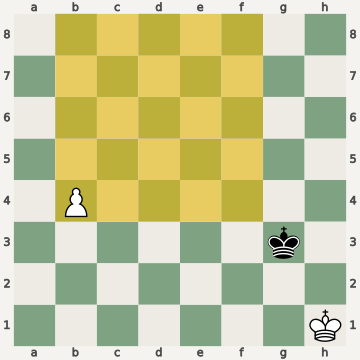
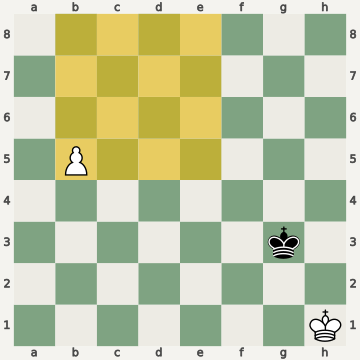
The only difference between the two positions is whose move it is, which is why the rule is really about tempo. Two refinements: a pawn on its starting rank can move two squares, so treat it as if it stood one rank higher; and the white king sitting nearby can change everything, because it can support the pawn or block the defender's king.
KEY SQUARES
When the pawn is not running alone, the attacker's king has a different job: to reach a key square. A key square is a square which, if the attacking king stands on it, guarantees that the pawn will promote regardless of what the defender does, provided the defending king is not able to capture the pawn or take the square first.
For a pawn on the fifth rank, such as White's pawn on e5, the three squares directly ahead on the sixth rank (d6, e6 and f6) are key squares. If White's king gets to any of them, the pawn queens, whoever is to move.
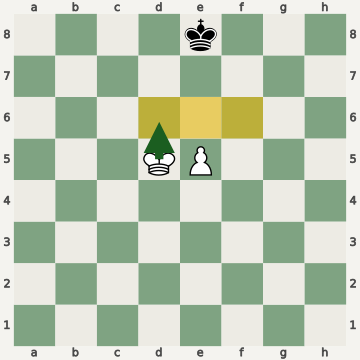
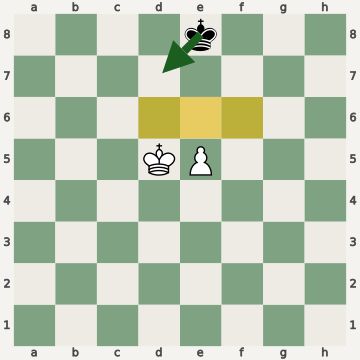
These two diagrams are the same position. The only thing that differs is who is to move, and that difference is the whole of the endgame. It is the reason players speak of "the opposition".
THE OPPOSITION
The kings are in opposition when they stand on the same file (or rank) with exactly one square between them. In that arrangement, the player who does not have to move holds the opposition, because the other king must give way: it has to step to a square that lets the opposing king advance.
In the second diagram above, the kings on d5 and d7 face each other with d6 between them. White to move would have to step aside; Black, having just moved there, does not. That is why ...Kd7 holds the draw: it is the most direct way to take the opposition.
Opposition is a tool for reaching key squares, not a law of nature. The rule of thumb that works across most positions is: if your king is ahead of your pawn, you want the opposition, and the defender wants to take it away from you. It is less useful once the pawn is far advanced, when the key squares are different, and with a rook pawn, where the rules change.
ROOK PAWNS ARE THE EXCEPTION
A pawn on the a- or h-file has the edge of the board on one side, so the defender's king has much more room to hide. If the defending king reaches the corner in front of the pawn, the position is a draw even if the attacker's king is next to the pawn.
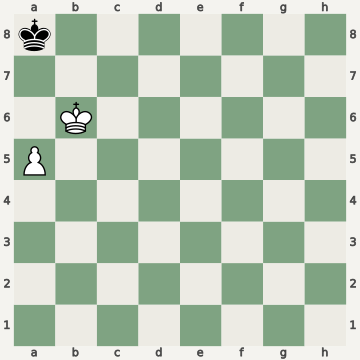
This is why a rook pawn plus king against a lone king in the corner is a standard drawing resource, and why trading into an ending with only a rook pawn is a classic way to save a worse position.
USING THIS IN YOUR OWN GAMES
- Before a queen trade or a minor-piece trade that leaves only pawns, ask yourself whether the resulting ending is won, drawn or lost. Use the rule of the square and the key squares to answer it, not intuition.
- Count tempi when kings are near the pawns. A single move often decides who holds the opposition.
- Keep the king active in the late middlegame. Kings that reach the centre early are the ones that arrive at key squares first.
- Look at the pawn endings in your lost games. If a drawn ending was lost because of a tempo, that is a concrete, fixable weakness.
The good news is that the number of these ideas is small. If you know these three, plus the fact that rook pawns are special, you will correctly evaluate the large majority of pawn endings you will actually reach.
Endgame errors are some of the most expensive in a game and the hardest to see by eye. Running your games through ChessDiary shows the exact move where a winning or drawn ending was lost.
Board diagrams are generated from the positions described in each caption. Piece graphics by Colin M.L. Burnett, used under CC BY-SA 3.0 / GPL via the python-chess library.