PINS, SKEWERS AND DISCOVERED ATTACKS
Forks use a single piece to attack two targets. Pins, skewers and discovered attacks do something different: they exploit the lines on which bishops, rooks and queens move. If you can picture those lines, a surprising number of tactics become visible; if you cannot, they appear to come out of nowhere.
These three patterns are related, and players often confuse them. This guide separates them, shows each one on a board, and explains how to defend.
KEY TAKEAWAYS
- A pin freezes a piece because moving it would expose something more valuable behind it; a skewer is the reverse: the valuable piece is in front and must move.
- A discovered attack uses one piece's move to open a line for another, so one move makes two threats.
- All three need a straight line (file, rank or diagonal), so the defence is the same: watch where your king and queen stand relative to enemy rooks, bishops and queens.
THE PIN
A pin happens when an attacking piece (a bishop, rook or queen) attacks an enemy piece that has something more valuable standing directly behind it on the same line. If the front piece moves, the piece behind it is captured.
There are two kinds. In an absolute pin the piece behind is the king, so moving the pinned piece is illegal. In a relative pin the piece behind is something valuable like a queen or rook, so the pinned piece may legally move, but doing so loses material.
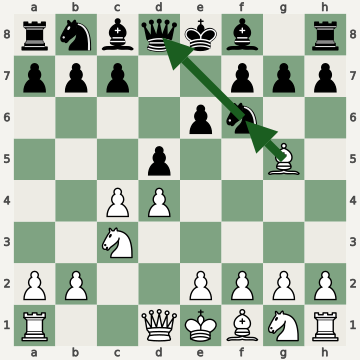
Two things make pins dangerous in practice. First, the pinned piece cannot do its job: a pinned knight does not guard what it normally guards, so pieces it protected can become loose. Second, you can pile up attackers on it, because it cannot run away. Attacking a pinned piece with a pawn or another piece is the standard way to win it.
The standard ways to deal with a pin are to break it (move the piece behind it, or interpose something less valuable), to attack the pinning piece, or to add a defender so that the pinned piece is protected enough to stay where it is. A quick check you can run on any position: which of my pieces stand on a line with my king or queen that an enemy bishop, rook or queen also stands on?
THE SKEWER
A skewer is a pin in reverse. The attacker hits a valuable piece, usually the king or queen, and when that piece moves out of the way, a less valuable piece behind it is captured.
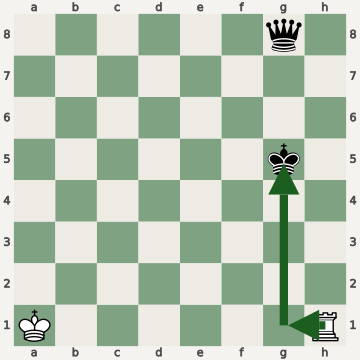
Skewers most often involve a king and queen on the same line, or a queen and rook. You see them in endgames, where kings are active and pieces are spread out, and in queen-for-rook situations after a trade. The warning sign is any time your king and one of your other pieces stand on a shared file, rank or diagonal with an enemy long-range piece able to reach that line.
THE DISCOVERED ATTACK
A discovered attack happens when you move one piece out of the way and uncover an attack by another piece behind it. The moving piece can make its own threat at the same time, so you create two threats with one move.
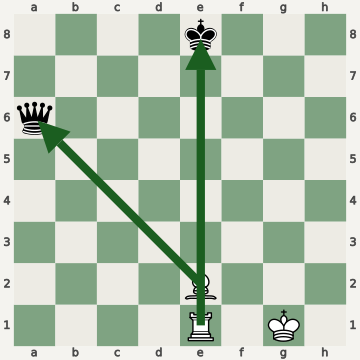
The strongest version is a discovered check, as above. The opponent has to answer the check, so the moving piece gets a free move: it can capture something, make a second threat, or retreat. A double check, where the moving piece also gives check, is even stronger because the king must move: you cannot block or capture your way out.
Discovered attacks are hard to defend because the danger is on the line behind the piece that moves. The way to see them is to ask, for any enemy piece that stands between its own rook, bishop or queen and your king or queen: what happens if that piece moves with a threat of its own?
TELLING THEM APART
| Tactic | What is attacked first | What decides it | How to avoid it |
|---|---|---|---|
| Pin | A piece that is less valuable than the one behind it | The front piece cannot (or should not) move | Keep king and queen off lines that enemy long-range pieces can reach |
| Skewer | The more valuable piece in front | It must move, exposing the one behind | Avoid placing king and queen (or queen and rook) on the same line |
| Discovered attack | Whatever the moved piece attacks, plus the line it opened | Two threats come from one move | Watch what stands between enemy long-range pieces and your valuables |
A PRACTICAL HABIT
All three tactics share one trigger: two of your valuable pieces, or your king and a valuable piece, standing on the same file, rank or diagonal. So before you move, scan the three lines through your king and your queen. Ask whether any enemy bishop, rook or queen already stands on them, or can reach them with a single move, and what stands between.
Playing these tactics is the same scan in reverse. Look for enemy pieces lined up on a file, rank or diagonal, and ask whether you can attack the front one with check, with a capture or with a threat that forces it to move. If you do this for every position, the patterns start to find you.
ChessDiary tags flagged moves with motifs including pin, skewer and discovered attack, so you can see after a batch of games which of these line-based tactics you actually miss.
Board diagrams are generated from the positions described in each caption. Piece graphics by Colin M.L. Burnett, used under CC BY-SA 3.0 / GPL via the python-chess library.