THE EVERGREEN GAME, ANNOTATED
The Evergreen Game is the companion piece to the Immortal Game and is usually described as the more accurate of the two. White opens with the Evans Gambit, sacrifices a pawn early, and ends with a rook sacrifice and a queen sacrifice leading to a forced mate. The name came from Wilhelm Steinitz, who called it “evergreen”.
Does it hold up under a modern engine? Mostly, with one large exception that is the real point of this page: the middle of the game turns on two moves each worth more than four pawns. One is White’s famous knight sacrifice; the other is Black’s reply a couple of moves later.
About these numbers. The evaluations on this page come from Stockfish 17.1, searched to depth 24 with a 20-second cap per position, and were run for this page; they are not output from ChessDiary’s own pipeline. Scores are in pawns from White’s point of view (positive favours White, negative favours Black). A different engine version, depth or computer can give slightly different numbers, so read them as approximate sizes of swings, not exact values. Move numbering follows the standard published score of the game.
THE GAME IN ONE GRAPH
This game is far less steady than the legend suggests. The line below swings several times before the final forced mate.
KEY MOMENTS
The opening: the Evans Gambit
The Evans Gambit offers the b-pawn to deflect Black’s bishop and prepare c3 and d4. The engine rates the position after 4.b4 at +0.18, so the gambit costs White only a small amount objectively, although the engine prefers the quiet c3 on this move.
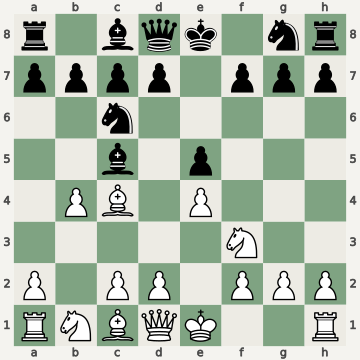
Black accepts and the opening goes as the theory books describe. Through move 9 the engine has the position within about half a pawn of equal, and nobody has made an error larger than 38 centipawns. That is the standard for a good gambit: initiative in return for a pawn, without a clear objective cost.
11…b5: Black’s best chance, thrown away
After 10.Re1 and 11.Ba3 White has over-extended: the engine now has Black ahead by about 0.68 pawns. The pawn push 11…b5 attacks the bishop, and looks natural, but the evaluation swings from −0.68 to +0.97, a loss of 165 centipawns. The engine prefers d5, a central break that keeps White’s pieces boxed in.
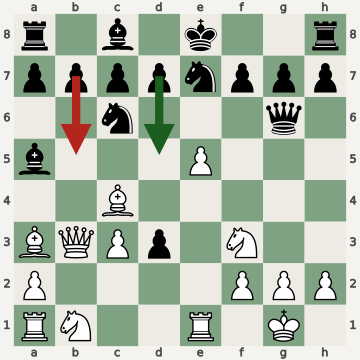
In practical terms: Black was the one with the better position, and one move gave it away. The pawn on b5 became a target and the b-file opened for White’s queen.
17.Nf6+: the sacrifice that was too early
By move 17 White has built a large advantage, +4.69 on the engine’s scale. Then the famous knight sacrifice 17.Nf6+ drops the evaluation to +0.57, a loss of 412 centipawns, because the sacrifice gives up a piece for an attack that is not yet decisive. The engine prefers the modest Ng3, which keeps almost everything.
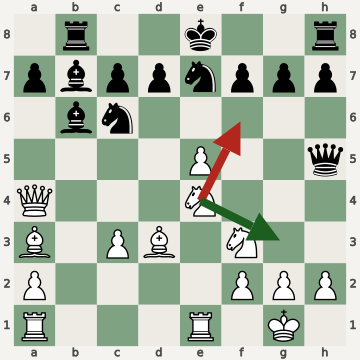
The game is remembered for 17.Nf6+, but a modern coach would use this position to teach the opposite lesson: when you are already winning, you do not need the spectacular move.
19…Qxf3: grabbing the queen
After the sacrifice the position is balanced: the engine says 0.00. Black’s queen takes the knight on f3, which looks like a clean win of material, but the evaluation jumps to +4.10, a loss of 410 centipawns. The engine prefers Bd4, a bishop move that keeps the position in balance.
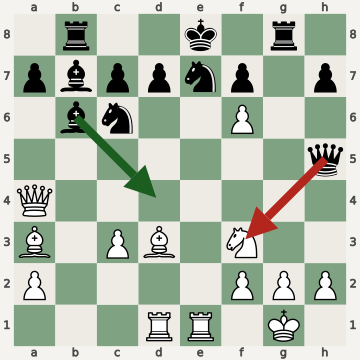
The capture takes the queen away from the defence of the king and the e7-knight, which White now attacks with the rook. After 20.Rxe7+ Black’s next move, 20…Nxe7, walks into a forced mate, and the engine instead recommends 20…Kd8.
21.Qxd7+: mate in four
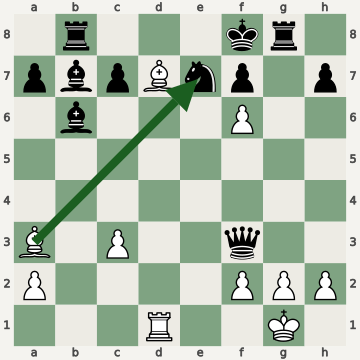
This is the part of the legend that is entirely true. The engine reports a mate in 4 for White here, and Black’s defences in the finish are the engine’s best ones, so the mate cannot be avoided. The queen sacrifice on d7 pulls the king onto the d-file, the bishop checks it back to e8, and the bishop and rook finish the game.
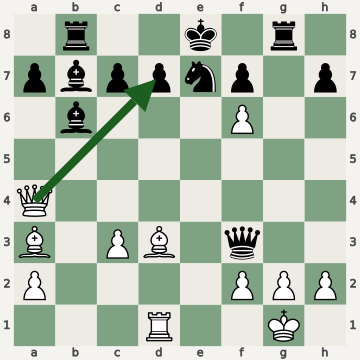
The final position: mate with two bishops and a rook
White has given up a queen, a rook and a knight, yet two bishops and a pawn are enough. The bishop on a3, the piece Black attacked with 11…b5, is the one that delivers mate along the a3–f8 diagonal, which links the opening to the finish.
EVERY MOVE THE ENGINE FLAGGED
The same quality labels ChessDiary uses, applied to this game: inaccuracy (roughly 40–90 centipawns lost), mistake (90–200) and blunder (200 and more, or a forced mate for the opponent). In the opening, a label means the move scores worse than the engine's top choice by that much, not that the line is unplayable.
| Move | Quality | Eval after | Centipawn loss | Engine preferred |
|---|---|---|---|---|
| 10.Re1 | Inaccuracy | −0.17 | 43 | Ba3 |
| 11.Ba3 | Inaccuracy | −0.68 | 44 | Re3 |
| 11...b5 | Mistake | +0.97 | 165 | d5 |
| 14.Nbd2 | Inaccuracy | +0.52 | 44 | Qd1 |
| 14...Bb7 | Mistake | +1.91 | 139 | O-O |
| 15...Qf5 | Blunder | +4.47 | 261 | d2 |
| 17.Nf6+ | Blunder | +0.57 | 412 | Ng3 |
| 19.Rad1 | Inaccuracy | 0.00 | 46 | Be4 |
| 19...Qxf3 | Blunder | +4.10 | 410 | Bd4 |
| 20...Nxe7 | Blunder | mate in 4 for White | — | Kd8 |
| 21...Kxd7 | Blunder | mate in 3 for White | — | Kxd7 |
| 22...Ke8 | Blunder | mate in 2 for White | — | Ke8 |
| 23...Kf8 | Blunder | mate in 1 for White | — | Kf8 |
THE FULL MOVE LIST
| # | White | Black |
|---|---|---|
| 1 | e4 | e5 |
| 2 | Nf3 | Nc6 |
| 3 | Bc4 | Bc5 |
| 4 | b4 | Bxb4 |
| 5 | c3 | Ba5 |
| 6 | d4 | exd4 |
| 7 | O-O | d3 |
| 8 | Qb3 | Qf6 |
| 9 | e5 | Qg6 |
| 10 | Re1 | Nge7 |
| 11 | Ba3 | b5 |
| 12 | Qxb5 | Rb8 |
| 13 | Qa4 | Bb6 |
| 14 | Nbd2 | Bb7 |
| 15 | Ne4 | Qf5 |
| 16 | Bxd3 | Qh5 |
| 17 | Nf6+ | gxf6 |
| 18 | exf6 | Rg8 |
| 19 | Rad1 | Qxf3 |
| 20 | Rxe7+ | Nxe7 |
| 21 | Qxd7+ | Kxd7 |
| 22 | Bf5+ | Ke8 |
| 23 | Bd7+ | Kf8 |
| 24 | Bxe7# |
WHAT TO TAKE FROM THIS GAME
- The brilliant parts are not always the best moves. 17.Nf6+ gave away most of a winning advantage, and Black had equal chances right up to 19…Qxf3.
- Material can mislead. 19…Qxf3 won a knight and lost the game. The exchanges that matter are the ones that change which of your pieces are still defending.
- A forced finish only has to be found once. Once the mate on move 21 is available, every move is forced. Calculating forcing moves first (checks, captures, threats) is the discipline that finds it; see Candidate Moves and Calculation.
- Gambits are judged by what they give. The Evans Gambit costs White little in the engine’s eyes, and gains the initiative that the rest of the game uses.
ChessDiary produces this kind of report for your own games: the evaluation line, the moves where it swung, and what the engine preferred. Upload a scoresheet, a PGN, or sync a Chess.com or Lichess account.
Board diagrams are generated from the positions described in each caption. Piece graphics by Colin M.L. Burnett, used under CC BY-SA 3.0 / GPL via the python-chess library.