THE IMMORTAL GAME, ANNOTATED
The Immortal Game is the most reprinted attacking game in chess. White gives up a bishop, both rooks and the queen, and then mates with the three minor pieces that remain. Almost every account of it is admiring. This page does something different: it runs a modern engine over every move, so you can see which parts of the legend hold up and which do not.
The short version is that the engine does not find the game as flawless as the story suggests. White’s sacrifices do work, but several of them only work because Black’s defence fell apart at specific moments. That is useful for a club player: it shows that a bold attack and a correct attack are not the same thing, and how a single reply can swing the evaluation by more than two pawns.
About these numbers. The evaluations on this page come from Stockfish 17.1, searched to depth 24 with a 20-second cap per position, and were run for this page; they are not output from ChessDiary’s own pipeline. Scores are in pawns from White’s point of view (positive favours White, negative favours Black). A different engine version, depth or computer can give slightly different numbers, so read them as approximate sizes of swings, not exact values. Move numbering follows the standard published score of the game.
THE GAME IN ONE GRAPH
Each point below is the engine’s evaluation after one half-move. Watch where the line moves, not just how high it ends.
KEY MOMENTS
The opening: a gambit that is not objectively best
Anderssen opens with the King’s Gambit. After 3…Qh4+ he has to move his king, and 4.Kf1 costs him castling for the rest of the game. At depth 24 the engine rates this position at −0.62, a small edge for Black, and it prefers Nf3 over 2.f4 on move two (a loss of about 87 centipawns for the gambit).
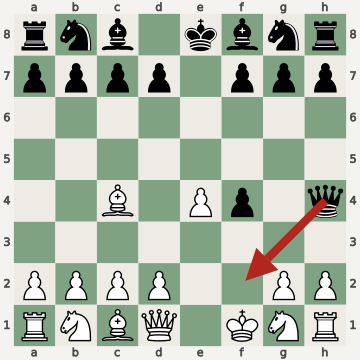
That is not a refutation. A deficit of this size is easily within what a stronger attacking player can play for, and Black’s own next move, 4…b5, is a gambit in return (the engine prefers d6, which keeps Black a little ahead). The lesson is that this type of opening makes the position sharp, not good for one side.
8.Nh4: the first real mistake
Before this move White has a slight advantage, +0.59. After 8.Nh4 the evaluation drops to −0.95, a loss of 154 centipawns, because the knight heads for the edge of the board, attacking the queen but leaving the centre. The engine prefers Rg1, which brings the rook into play on the open g-file.
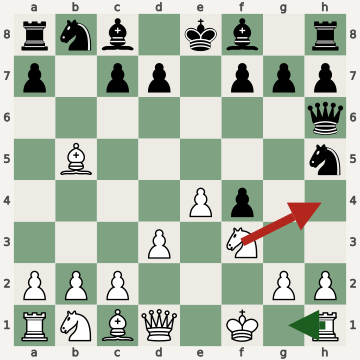
It gets worse a move later: 10.g4 drops the evaluation from +0.30 to −1.30, with the engine preferring Ba4. By that point Black is clearly better by the numbers. White’s play looks wild, and it is, but this is where the attack is objectively behind.
11…cxb5: the move that gave the game back
This is the turning point. Here Black is the one who is better, by 0.64 pawns in Black’s favour. Taking the bishop on b5 looks natural, and wins material, yet the evaluation moves from −0.64 to +1.65, a swing of 229 centipawns. The engine’s preference is h5, a quiet move that stops White’s h-pawn from advancing.
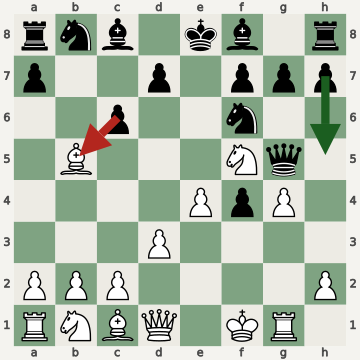
Why does an extra piece not help? After 11…cxb5 Black has opened the c- and b-files near his own king and given White time for h4 and h5, with the queen driven back and the pieces still aiming at the kingside. The moment to ask “what does my opponent get for this piece?” was just before taking. This is the kind of swing that the candidate-moves routine is built to catch.
18.Bd6: brilliant, and not the best move
This is the position in which the Immortal Game earned its name. White is already winning on the engine’s numbers (+3.99). The bishop sacrifice on d6 keeps a decisive advantage, but the evaluation is +1.67 afterwards, a drop of 232 centipawns. The engine prefers Re1, a quieter move that keeps more of the advantage.
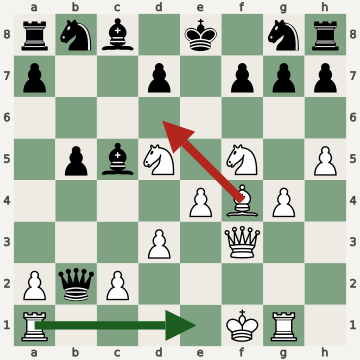
Black’s reply was also not the best. After 18…Bxg1 the evaluation climbs back to +3.54; the engine prefers Qxa1+, taking the other rook with check first. The famous middle of the game is a sequence of two inexact moves that both lead to White still being on top.
20…Na6: the move that loses by force
Black is already behind, at +3.88 for White, but still in the game. 20…Na6 develops a piece, but it ignores White’s threat, and the engine now sees a mate in 3 for White. The bishop move 20…Ba6 is its choice and keeps the game going, even though Black remains clearly worse.
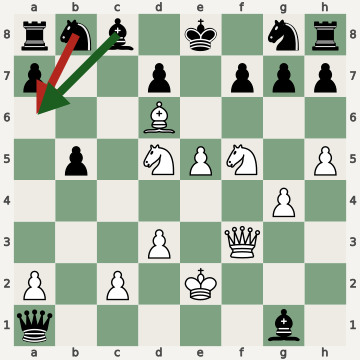
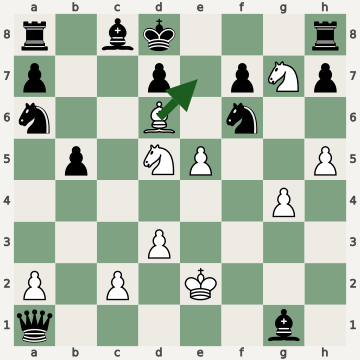
From here the finish is forced: 21.Nxg7+ Kd8 22.Qf6+ Nxf6 23.Be7#. The continuation is forced, and from here the queen sacrifice is objectively sound.
The final position: a mate with three minor pieces
The final mate is a pattern worth knowing in itself. Black’s king is hemmed in by his own pieces; the bishop on e7 gives check, the knights on d5 and g7 cover the two squares left, and Black’s own pieces block the rest. White has sacrificed the queen and both rooks and still has mate with minor pieces alone.
EVERY MOVE THE ENGINE FLAGGED
The same quality labels ChessDiary uses, applied to this game: inaccuracy (roughly 40–90 centipawns lost), mistake (90–200) and blunder (200 and more, or a forced mate for the opponent). In the opening, a label means the move scores worse than the engine's top choice by that much, not that the line is unplayable.
| Move | Quality | Eval after | Centipawn loss | Engine preferred |
|---|---|---|---|---|
| 2.f4 | Inaccuracy | −0.56 | 87 | Nf3 |
| 4...b5 | Inaccuracy | 0.00 | 62 | d6 |
| 7.d3 | Inaccuracy | −0.28 | 59 | d4 |
| 7...Nh5 | Inaccuracy | +0.59 | 87 | c6 |
| 8.Nh4 | Mistake | −0.95 | 154 | Rg1 |
| 9...c6 | Inaccuracy | +0.30 | 89 | g6 |
| 10.g4 | Mistake | −1.30 | 160 | Ba4 |
| 10...Nf6 | Inaccuracy | −0.62 | 68 | g6 |
| 11...cxb5 | Blunder | +1.65 | 229 | h5 |
| 14...Ng8 | Inaccuracy | +2.53 | 61 | Bb7 |
| 16...Bc5 | Mistake | +4.56 | 169 | Qc6 |
| 17.Nd5 | Inaccuracy | +3.79 | 77 | d4 |
| 18.Bd6 | Blunder | +1.67 | 232 | Re1 |
| 18...Bxg1 | Mistake | +3.54 | 187 | Qxa1+ |
| 19.e5 | Mistake | +2.42 | 112 | Re1 |
| 19...Qxa1+ | Inaccuracy | +2.89 | 47 | Qxa1+ |
| 20...Na6 | Blunder | mate in 3 for White | — | Ba6 |
| 21...Kd8 | Blunder | mate in 2 for White | — | Kd8 |
| 22...Nxf6 | Blunder | mate in 1 for White | — | Nxf6 |
THE FULL MOVE LIST
| # | White | Black |
|---|---|---|
| 1 | e4 | e5 |
| 2 | f4 | exf4 |
| 3 | Bc4 | Qh4+ |
| 4 | Kf1 | b5 |
| 5 | Bxb5 | Nf6 |
| 6 | Nf3 | Qh6 |
| 7 | d3 | Nh5 |
| 8 | Nh4 | Qg5 |
| 9 | Nf5 | c6 |
| 10 | g4 | Nf6 |
| 11 | Rg1 | cxb5 |
| 12 | h4 | Qg6 |
| 13 | h5 | Qg5 |
| 14 | Qf3 | Ng8 |
| 15 | Bxf4 | Qf6 |
| 16 | Nc3 | Bc5 |
| 17 | Nd5 | Qxb2 |
| 18 | Bd6 | Bxg1 |
| 19 | e5 | Qxa1+ |
| 20 | Ke2 | Na6 |
| 21 | Nxg7+ | Kd8 |
| 22 | Qf6+ | Nxf6 |
| 23 | Be7# |
WHAT TO TAKE FROM THIS GAME
- Brilliant is not the same as best. The engine prefers a different move at 18.Bd6, and a gambit that is objectively slightly worse can still be the right practical choice.
- Most of the damage came from a few moves. The biggest swings are 11…cxb5, 18.Bd6, 18…Bxg1 and 20…Na6. Finding the three or four moves that matter is what a review is for.
- Greedy captures need a check. 11…cxb5 won a piece and lost most of the advantage. Before any capture, ask what the opponent gets in return.
- Know the finishing pattern. The mate on move 23 uses a bishop and two knights against a boxed-in king. See Checkmate Patterns Every Player Should Know.
This is the same kind of report ChessDiary produces for your own games: the evaluation line, the moves where it swung, and the better move for each. Upload a scoresheet, a PGN, or sync a Chess.com or Lichess account to try it on a game you played.
Board diagrams are generated from the positions described in each caption. Piece graphics by Colin M.L. Burnett, used under CC BY-SA 3.0 / GPL via the python-chess library.