THE GAME OF THE CENTURY, ANNOTATED
Bobby Fischer was 13 when he played this game against Donald Byrne, one of the strongest players in the United States. The chess writer Hans Kmoch called it “The Game of the Century”, and it is still the most famous game of Fischer’s youth. It is remembered for one move: on move 17 Fischer left his queen to be taken and won the game with the pieces he got back.
Unlike the Immortal and Evergreen games, this one survives a modern engine almost intact. Fischer’s two famous moves are both the engine’s own first choice. The two moves that decided the game were White’s: one natural-looking bishop move in the opening, and the decision to take the queen.
About these numbers. The evaluations on this page come from Stockfish 17.1, searched to depth 24 for every position, and were run for this page; they are not output from ChessDiary’s own pipeline. Scores are in pawns from White’s point of view (positive favours White, negative favours Black). A different engine version, depth or computer can give slightly different numbers, so read them as approximate sizes of swings, not exact values. Move numbering follows the standard published score of the game.
THE GAME IN ONE GRAPH
The line stays close to level for ten moves, drops sharply twice, and never comes back. Everything after move 18 is Black converting a winning position.
KEY MOMENTS
The opening: a Grünfeld by transposition
The game starts with 1.Nf3 and 2.c4, and by move 5 it has become a Grünfeld Defence: Black lets White build a big pawn centre and plans to attack it with pieces. For ten moves both players stay within about three-quarters of a pawn of level. White’s queen moves often (Qb3, Qxc4, Qc5), and the engine marks 6.Qb3 and 10.Qc5 as small inaccuracies, but nothing has gone wrong yet. After 10…Bg4 the engine rates the position +0.25.
11.Bg5: the move that let Fischer in
This is the real turning point, and it is White’s. Byrne moves his bishop a second time, from f4 to g5, while his king is still in the centre and the bishop on f1 has not moved. The evaluation drops from +0.25 to −2.35, a loss of 260 centipawns. The engine prefers 11.Be2, which develops the last minor piece and prepares to castle.
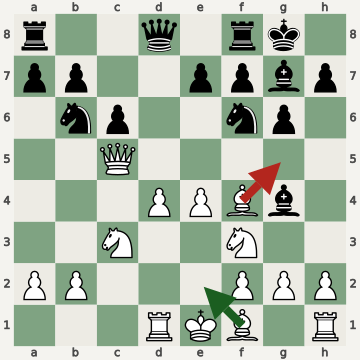
11…Na4: the engine’s first choice
Fischer’s reply puts a knight on a4, where White’s knight on c3 can take it. Annotators have always given it two exclamation marks, and the engine agrees: 11…Na4 is its top move. The point is that the knight on c3 is the only piece defending White’s pawn on e4. After 12.Qa3 Nxc3 13.bxc3 Nxe4 Black has won a pawn and White’s king is still in the centre. The evaluation hardly moves through these exchanges; the advantage was already there after 11.Bg5.
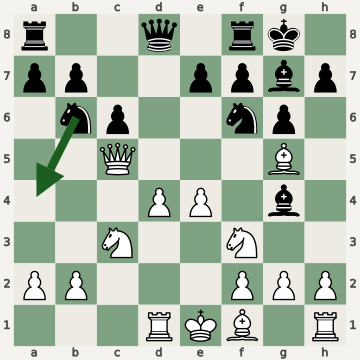
One small correction to the legend: after 14.Bxe7, Fischer’s 14…Qb6 is an inaccuracy by the engine’s count. It prefers 14…Qd5, which offers a queen trade and keeps Black about three pawns ahead in a simpler position. Fischer chose the sharper path, and it worked.
17…Be6: the queen offer
This is the move the game is famous for. Black’s queen on b6 is attacked by the bishop on c5. Instead of moving it, Fischer plays 17…Be6, attacking White’s bishop on c4 and leaving the queen to be taken. 17…Be6 is the engine’s top move. It does not increase Black’s advantage: the evaluation stays at about −2.5 before and after. What makes the move special is that it was the best move in a position where the natural alternatives were worse.
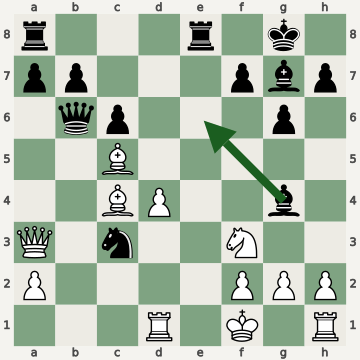
18.Bxb6: taking the queen
Taking the queen looks forced, but the engine disagrees. After 18.Bxb6 the evaluation falls from −2.67 to −6.21, a loss of 354 centipawns and the biggest single swing in the game. The engine prefers 18.Qxc3, taking the knight instead. Its main line, 18.Qxc3 Qxc5 19.dxc5 Bxc3, trades the queens and leaves White worse but still playing.
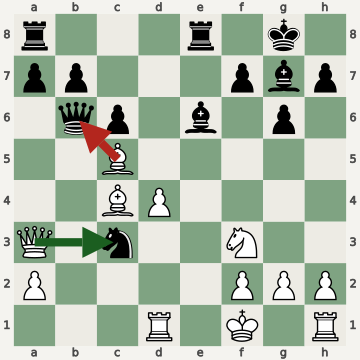
Taking the queen lets Black start a “windmill”: a series of discovered checks in which the White king walks between f1 and g1 while Black’s bishop and knight take material. In order, Black collects the bishop on c4, the pawn on d4 and the bishop on b6 (23…axb6). Two moves later the knight takes the rook on d1.
After the windmill: the material count
After 25…Nxd1 White has a queen, a rook, a knight and four pawns. Black has two rooks, two bishops, a knight and five pawns. So for the queen Black has a rook, two bishops and a pawn, and White’s king has almost no defenders. The engine rates the position −6.14.
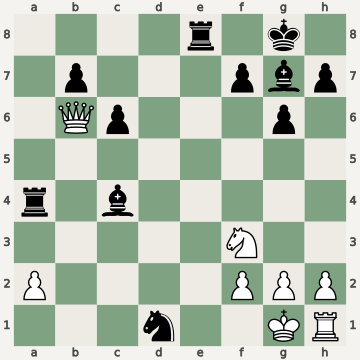
The rest of the game is the conversion, and it is not perfect. The engine marks 30…Bd5 and 32…b5 as mistakes. Each costs about a pawn of a seven- or eight-pawn advantage, so neither puts the result in doubt. White’s 34.Ne5 makes things worse, and after 35.Kg1 the engine finds a forced mate in 19.
The final position: mate with a rook and minor pieces
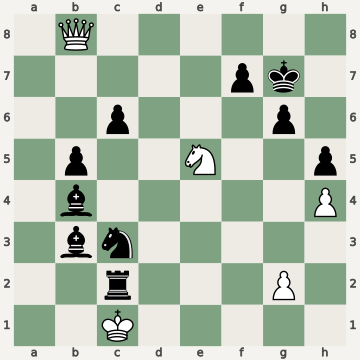
After 36.Kf1 the mate is only five moves away; 36.Kh2 would have lasted longer. The bishops and knight drive White’s king along the first rank to c1, and 41…Rc2# ends the game. The engine’s choice on the final move is 41…Ba3#, which is also mate.
EVERY MOVE THE ENGINE FLAGGED
The same quality labels ChessDiary uses, applied to this game: inaccuracy (roughly 40–90 centipawns lost), mistake (90–200) and blunder (200 and more, or a forced mate for the opponent). In the opening, a label means the move scores worse than the engine's top choice by that much, not that the line is unplayable. Two moves are left out: 29.Qd8+ and 33.h4 were the engine’s own first choice, and the small drop in score after them is search noise.
| Move | Quality | Eval after | Centipawn loss | Engine preferred |
|---|---|---|---|---|
| 5.Bf4 | Inaccuracy | +0.11 | 41 | e4 |
| 6.Qb3 | Inaccuracy | −0.34 | 51 | Rc1 |
| 6...dxc4 | Inaccuracy | +0.09 | 43 | c5 |
| 8...Nbd7 | Inaccuracy | +0.73 | 63 | Qa5 |
| 10.Qc5 | Inaccuracy | +0.25 | 64 | Qb3 |
| 11.Bg5 | Blunder | −2.35 | 260 | Be2 |
| 14.Bxe7 | Inaccuracy | −2.98 | 71 | Be3 |
| 14...Qb6 | Inaccuracy | −2.32 | 66 | Qd5 |
| 18.Bxb6 | Blunder | −6.21 | 354 | Qxc3 |
| 20...Nxd4+ | Inaccuracy | −5.56 | 72 | Nc3+ |
| 25.Qxb6 | Inaccuracy | −6.09 | 41 | Qd6 |
| 30...Bd5 | Mistake | −6.85 | 132 | Ne4 |
| 31.Nf3 | Inaccuracy | −7.61 | 76 | h4 |
| 32...b5 | Mistake | −7.96 | 94 | h5 |
| 34.Ne5 | Mistake | −10.37 | 167 | Kh1 |
| 35.Kg1 | Blunder | mate in 19 for Black | — | Nxf7 |
| 36.Kf1 | Blunder | mate in 5 for Black | — | Kh2 |
| 37.Ke1 | Blunder | mate in 4 for Black | — | Ke1 |
| 38.Kd1 | Blunder | mate in 3 for Black | — | Kd1 |
| 39.Kc1 | Blunder | mate in 3 for Black | — | Kc1 |
| 40.Kb1 | Blunder | mate in 2 for Black | — | Kb1 |
| 41.Kc1 | Blunder | mate in 1 for Black | — | Kc1 |
THE FULL MOVE LIST
| # | White | Black |
|---|---|---|
| 1 | Nf3 | Nf6 |
| 2 | c4 | g6 |
| 3 | Nc3 | Bg7 |
| 4 | d4 | O-O |
| 5 | Bf4 | d5 |
| 6 | Qb3 | dxc4 |
| 7 | Qxc4 | c6 |
| 8 | e4 | Nbd7 |
| 9 | Rd1 | Nb6 |
| 10 | Qc5 | Bg4 |
| 11 | Bg5 | Na4 |
| 12 | Qa3 | Nxc3 |
| 13 | bxc3 | Nxe4 |
| 14 | Bxe7 | Qb6 |
| 15 | Bc4 | Nxc3 |
| 16 | Bc5 | Rfe8+ |
| 17 | Kf1 | Be6 |
| 18 | Bxb6 | Bxc4+ |
| 19 | Kg1 | Ne2+ |
| 20 | Kf1 | Nxd4+ |
| 21 | Kg1 | Ne2+ |
| 22 | Kf1 | Nc3+ |
| 23 | Kg1 | axb6 |
| 24 | Qb4 | Ra4 |
| 25 | Qxb6 | Nxd1 |
| 26 | h3 | Rxa2 |
| 27 | Kh2 | Nxf2 |
| 28 | Re1 | Rxe1 |
| 29 | Qd8+ | Bf8 |
| 30 | Nxe1 | Bd5 |
| 31 | Nf3 | Ne4 |
| 32 | Qb8 | b5 |
| 33 | h4 | h5 |
| 34 | Ne5 | Kg7 |
| 35 | Kg1 | Bc5+ |
| 36 | Kf1 | Ng3+ |
| 37 | Ke1 | Bb4+ |
| 38 | Kd1 | Bb3+ |
| 39 | Kc1 | Ne2+ |
| 40 | Kb1 | Nc3+ |
| 41 | Kc1 | Rc2# |
WHAT TO TAKE FROM THIS GAME
- Finish development before you go hunting. 11.Bg5 moved an already-developed bishop while the f1-bishop sat at home and the king stood in the centre. That one move cost White more than two pawns. See Chess Opening Principles.
- Count what the opponent gets back, not just what you win. 18.Bxb6 won a queen and lost the game, because Black won back a rook, two bishops and a pawn, mostly with check.
- A famous move does not have to swing the evaluation. 17…Be6 kept Black’s advantage rather than increasing it. Sometimes the brilliant move is simply the only good one.
- Winning positions forgive small errors. Fischer’s 30…Bd5 and 32…b5 each cost about a pawn, and with a seven-pawn lead they did not matter. When you review your own wins, look for the moves that changed the result, not every centipawn.
ChessDiary produces this kind of report for your own games: the evaluation line, the moves where it swung, and what the engine preferred. Upload a scoresheet, a PGN, or sync a Chess.com or Lichess account.
Board diagrams are generated from the positions described in each caption. Piece graphics by Colin M.L. Burnett, used under CC BY-SA 3.0 / GPL via the python-chess library.